When award-winning playwright and Michigan State University alum Sandra Seaton returned to Wharton Center for Performing Arts for the world premiere of Sally: A Solo Play, it was both a creative milestone and a homecoming. The production brought Seaton’s 15-year engagement with Sally Hemings to a stage that has long shaped her artistic life — one she calls “a home away from home.”

Sally: A Solo Play, Seaton’s deeply researched and powerful work, reclaims the voice and humanity of Sally Hemings, whose life is often reduced to a footnote in the story of Thomas Jefferson, the third President of the United States and primary author of the Declaration of Independence.
Born into slavery, Sally Hemings was the half-sister of Jefferson’s wife, Martha. Jefferson inherited Hemings, among many others who were enslaved, from his father-in-law and has been confirmed through DNA as the father of her children.
For generations, American history has focused on the architects of the nation while relegating the lives of enslaved people to the margins. Hemings is frequently mentioned alongside Jefferson but rarely in ways that fully represent her life, agency, or humanity.
“My portrayal of Sally Hemings challenges the way she has been viewed in the past…I wanted her to have her own voice and for people to see this multilayered, complicated woman — not an appendage to Jefferson — but a person whose life deserves attention.”
Sandra Seaton
Sally: A Solo Play places Hemings at the center of her own story and is told from her perspective in a work that is as much about historical truth as it is about humanity. Set at Monticello, Jefferson’s home near Charlottesville, Virginia, in 1826 near the end of Jefferson’s life, the play unfolds as a memory piece as Hemings fights to ensure her children will be freed from slavery at age 21, an earlier promise made by Jefferson.
“My portrayal of Sally Hemings challenges the way she has been viewed in the past. Because she was enslaved, that has often become her only identity,” Seaton said. “I wanted her to have her own voice and for people to see this multilayered, complicated woman — not an appendage to Jefferson — but a person whose life deserves attention.”


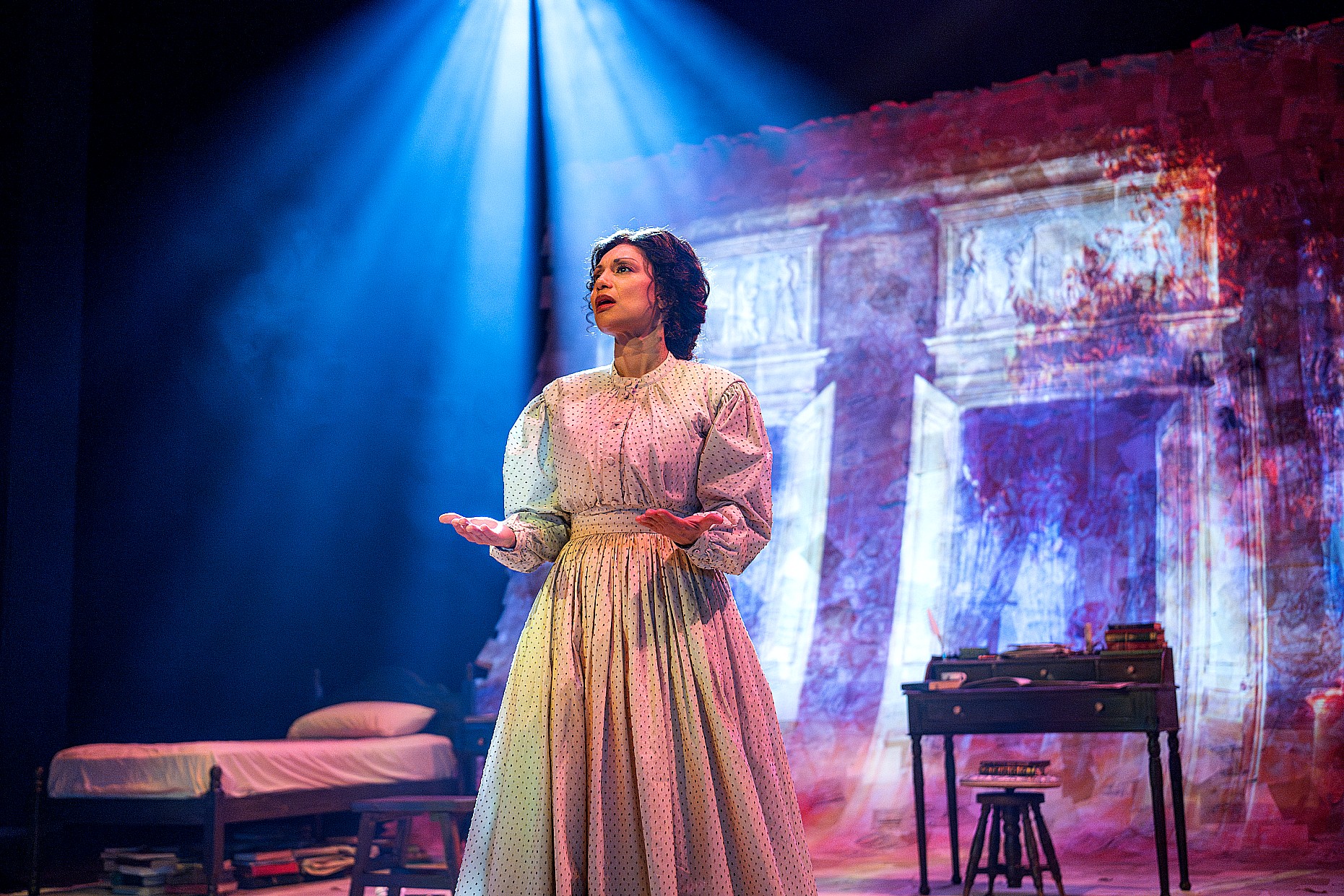
That commitment to reclaiming marginalized voices has been a hallmark of Seaton’s long and successful career. A nationally recognized playwright, poet, and librettist, her acclaimed works have premiered at major venues including Carnegie Hall, the Kennedy Center, and LA Opera.
She is best known for From the Diary of Sally Hemings, set to music by Pulitzer Prize-winning Composer William Bolcom; The Passion of Mary Caldwell Dawson, for Mezzo-Soprano Denyce Graves with music by Composer Carlos Simon; and for her Pulitzer Prize-nominated Dreamland: Tulsa 1921, a “ploratorio,” play with oratorio, created with Composer Marques L.A. Garrett.
Education, Influence, and Early Work
Seaton’s career is rooted in part in her time at Michigan State University, where she studied creative writing and was mentored by members of the Department of English faculty. She earned her M.A. in Creative Writing from MSU in 1988.
However, Seaton’s journey toward playwriting began long before graduate school. Born and raised in Columbia, Tennessee, she was an avid reader who never wanted to put a book down. Her earliest artistic influence came from her grandmother, who recited the poetry of Paul Laurence Dunbar, played ragtime piano, performed skits for Seaton, and appeared in amateur minstrel shows.

“My grandmother was really my first entry into the world of the creative arts,” Seaton said. “That was my introduction.”
When Seaton went to college at the University of Illinois Urbana-Champaign, she studied journalism and initially thought she wanted to become a journalist. That path soon gave way to a deeper pull toward artistic expression, which led her to earn a B.A. in Creative Writing.
“I took this creative writing course and really fell in love with it,” she said. “I took a lot of fiction writing. I took playwriting and a poetry course. That was really the beginning of my world as a writer. Of course, we didn’t have computers. I had a Smith Corona electric typewriter and used easy-erase paper. Most of the time, you had to write the whole thing over again. You couldn’t just edit like you do now. And when I did a cut and paste, I used scissors and tape.”
At the time, Seaton was one of only two Black students majoring in English at the University of Illinois, and she never had a Black professor.
“I don’t think there was one Black professor at Illinois. I never saw one,” she said. “But now, things I never dreamed of happening have happened.”
“When I began to write, I wrote about the world I knew — the African American community I grew up around…It was amazing how little people knew about our world.”
Sandra Seaton
As an undergraduate, Seaton was struck by how unfamiliar many of her peers were with Black literature and cultural history.
“I was surprised when I went to college that no one had ever heard of Paul Laurence Dunbar,” she said. “That was the beginning of my understanding of how little the general populous knew about Black literature or ‘our contribution.’”

That realization shaped Seaton’s creative direction.
“When I began to write, I wrote about the world I knew — the African American community I grew up around,” she said. “My mother and aunts were teachers. They had their clubs and their bridge parties. My mother would take me to her one-room country schoolhouse sometimes. That was the world I knew. It was amazing how little people knew about our world.”
It was also at the University of Illinois where Seaton met her husband, James, who was also an undergraduate at the time. They moved to East Lansing in 1971 when James became a faculty member in MSU’s Department of English. About six months later, Seaton also began working at MSU as a no-preference advisor in the Undergraduate University Division. Later, she began taking graduate courses, which deepened her commitment to fiction, poetry, and playwriting, all while working as an academic advisor, temping at Kelley Services, and raising four children.
“I kept crayons and drawing paper on the floor to keep my kids busy while I finished assignments,” she said. “And as I dedicated myself to my graduate courses in fiction writing, playwriting, and literature, with the support of wonderful mentors in MSU’s English Department, I found myself listening to the hopes and dreams of the undergraduate students who sought me out as an advisor. Even as I struggled with my own challenges related to my educational and career goals, I found myself becoming a participant in the journeys of a wide array of students pursuing their own goals.”

Seaton’s play, The Bridge Party, which was part of her master’s thesis, went on to win the 1989 Theodore Ward Prize for African American Playwrights and was performed at the University of Michigan’s Arthur Miller Theatre in 1988, starring Ruby Dee. In 2000, MSU’s Arena Theatre hosted a full production of The Bridge Party featuring actor Adilah Barnes.
Shortly after Seaton earned her M.A., she was hired to teach Creative Writing and African American Literature at Central Michigan University. She taught at CMU for 15 years, mentoring new generations of storytellers while building a distinguished body of work that continues to help shape American theatre.
Finding Sally Hemings’ Voice
Seaton never set out to write about Sally Hemings. The idea emerged through her collaboration with Composer William Bolcom, who saw a performance of The Bridge Party and believed Seaton’s treatment of the characters made her uniquely suited to tell Hemings’ story. Their collaboration resulted in From the Diary of Sally Hemings, a song cycle commissioned by legendary Mezzo-Soprano Florence Quivar.

That work premiered at the Library of Congress’ Coolidge Auditorium in the Thomas Jefferson Building, with 45 of Hemings’ descendants in attendance, an experience Seaton describes as profoundly affirming.
“They sent me a note afterwards that said, ‘Thank you for your portrayal of our great- great-grandmother plus,’” Seaton said. “I didn’t know whether they were going to like it. You are writing about somebody’s family. But they did, so I felt really relieved. That meant everything to me.”

During that premiere, audience members encouraged Seaton to write a play about Sally Hemings, and she says “that was the spark.” In 2001, she wrote her first draft for the New York State Writer’s Institute solo play workshop.
“I kept working on it. I wrote at the kitchen sink, in the grocery store, whenever and wherever I could,” Seaton said. “I have boxes and boxes of drafts of Sally…I don’t think of it as revising. It’s more like parenting. The work grows, changes, and develops and you are there to guide it along.”
A Homecoming Collaboration
The world premiere of Sally: A Solo Play at Wharton Center held deep personal meaning for Seaton, whose connection to the venue dates back to its opening, which she attended with her family at which they met Clifton and Dolores Wharton.
“The Wharton is where I have gone to see things I would have never been able to see. Over the years, it has had such a great impact on the community,” Seaton said. “It meant a lot to me that my play Sally was at the Wharton. It was like going home, and that was really very special.”

The production was a collaborative effort that included two faculty from MSU’s Department of Theatre as part of the creative team, both of whom have worked with Seaton on projects in the past.
Kirk Domer, Interim Chairperson and Professor of Scene Design, served as Scene Designer for the production. He created 3D renderings that served as the basis for which the scenery was constructed.
“I always look forward to new work, as the creative teams’ contributions to the evolution of the play are powerful and have an enduring impact on future iterations of the work,” Domer said. “This one invites audiences to see a new view of a historical person and rethink their past experience with this history that they have only experienced from one point of view.”

Alison Dobbins, Professor of Integrated Media Performance Design, served as Projection Designer for Sally. Her work helped audiences navigate the play’s shifting emotional and temporal landscapes.
“It is incredibly exciting to be part of something that is being formed for the first time,” Dobbins said. “This story is full of the complexity, hard choices, and unresolved conflicts that the founders of this country left for the rest of us to solve.”
Both faculty members emphasized the importance of bringing this world premiere to East Lansing, offering the MSU community the opportunity to engage with Black history through contemporary theatrical storytelling.
‘Diversity is not an ugly word‘
Sally: A Solo Play premiered at Wharton Center’s Pasant Theatre Feb. 19-21, 2026. It asked audiences to reconsider whose stories have been told, whose have been overlooked, and how we engage with diversity.
Seaton once was told by another theatre, which she was hoping would host a production of The Bridge Party, that it “only did one Black play a year” and “didn’t want to be known as a Black theatre.”


“Diversity is not an ugly word,” Seaton said. “What the Wharton Center has done in bringing in so many different companies and organizations, is just great.”
For Seaton, the goal of Sally: A Solo Play, and of her writing more broadly, is not to provide answers but to invite understanding.
“There’s no such thing as a ‘Black character’ or a character who’s a slave, or a character who’s a woman,” she said. “Creative writing is about the particular. It’s not about the general. It’s about seeing an individual at a certain point in time. If you can see Sally Hemings as a multilayered, complicated person, this will allow you to see any African American or woman that you meet and not generalize about them. But try to understand their story.”
By Kim Popiolek
For more information on Sandra Seaton, read the “Graduate voice: How MSU shaped Sandra Seaton’s path to the stage and national recognition” article originally published by MSU Today.


