October 27, 2025
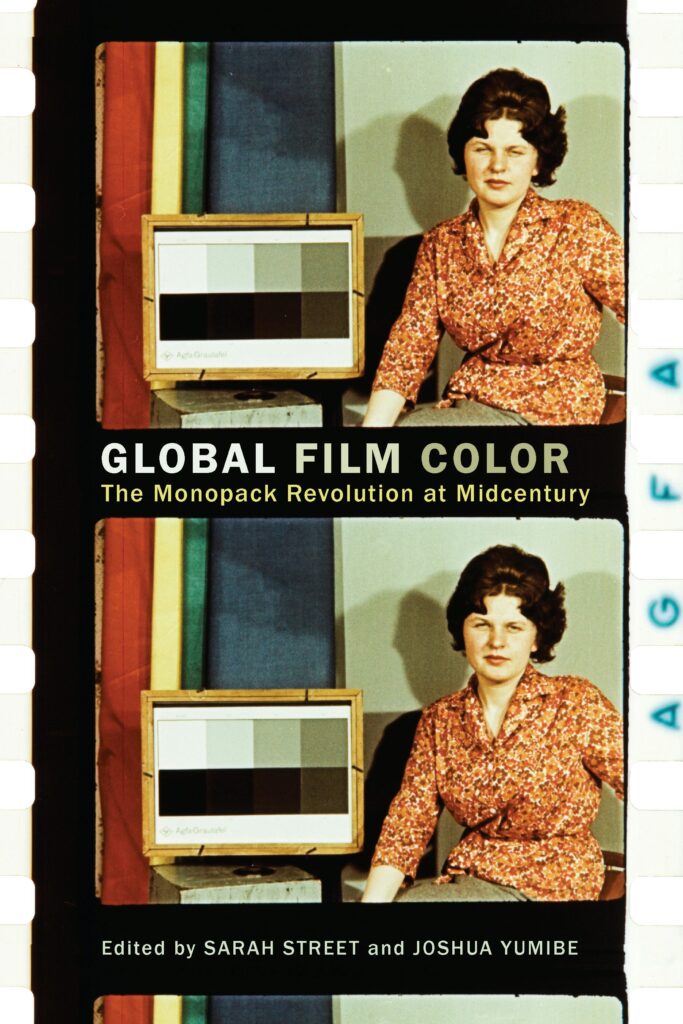
“Color has a double valence,” the syllabus for Joshua Yumibe’s Fall 2024 section of Film Studies 450: Studies in Ethnic Film announced. Color, in one context, describes hues: blues, reds, yellows, innovations in film. In another, it suggests racial categories: Blackness, whiteness, naturalized but ever-shifting categories of people. In Global Film Color: The Monopack Revolution at Midcentury, published by Rutgers University Press in 2024, Yumibe, his coeditor Sarah Street, and fifteen contributors investigate the gradual adoption of color film technologies across the Global North and South in the mid-twentieth century and what color meant to different filmmakers, industries, and audiences.
Yumibe, Research Foundation Professor of Film Studies at Michigan State University, is a leading scholar of the history of color film. He is the author of Moving Color: Early Film, Mass Culture, Modernism (Rutgers, 2012), coauthor of Fantasia of Color in Early Cinema (Amsterdam, 2015), and coeditor, also with Street, of Chromatic Modernity: Color, Cinema, and Media of the 1920s (Columbia, 2019). After publishing Chromatic Modernity, Yumibe and Street knew that they had unfinished business. That first volume had focused, as most histories of color film do, on the initial introduction of color technologies in the Global North during the interwar period. With Global Film Color, they set about, as Yumibe said, expanding “the questions we were researching temporally as well as geographically.” The new volume challenges conventional timelines of film history by revealing how “technological flows” from one country and continent to another are “multivalent and hybrid,” how the history of color film is also the history of empire, capitalism, and Cold War diplomacy.
Yumibe’s own contribution to the volume, “On Vivid Colors and Afrotropes in African and Diasporic Cinemas,” previews his next major project. He is currently at work on a book about that “double valence” of color in African and African diasporic cinemas, tentatively titled “Chromatic Blackness: Color, Race, and the Moving Image.”
As Yumibe wrote of color film in his first book, now more than a decade ago, “One can go on almost endlessly, which is a way of saying that color in its prismatic splendor is uncontainable.”